Frontline Hund S
Frontline Hund S may be available in the countries listed below.
In some countries, this medicine may only be approved for veterinary use.
Ingredient matches for Frontline Hund S
Fipronil is reported as an ingredient of Frontline Hund S in the following countries:
Important Notice: The Drugs.com international database is in BETA release. This means it is still under development and may contain inaccuracies. It is not intended as a substitute for the expertise and judgement of your physician, pharmacist or other healthcare professional. It should not be construed to indicate that the use of any medication in any country is safe, appropriate or effective for you. Consult with your healthcare professional before taking any medication.
Drugs.com Mobile Apps
The easiest way to lookup drug information, identify pills, check interactions and set up your own personal medication records. Available for Android and iOS devices.
About
Terms & Privacy
Subscribe to receive email notifications whenever new articles are published.
Drugs.com provides accurate and independent information on more than 24,000 prescription drugs, over-the-counter medicines and natural products. This material is provided for educational purposes only and is not intended for medical advice, diagnosis or treatment. Data sources include Micromedex® (updated Jan 31st, 2018), Cerner Multum™ (updated Feb 2nd, 2018), Wolters Kluwer™ (updated Feb 2nd, 2018) and others. To view content sources and attributions, please refer to our editorial policy.
We comply with the HONcode standard for trustworthy health information - verify here
Fipronil
In some countries, this medicine may only be approved for veterinary use.
CAS registry number (Chemical Abstracts Service)
Chemical Formula
Molecular Weight
Therapeutic Categories
Chemical Name
Foreign Name
- Fipronil (German)
Generic Names
- Fipronil (OS: BAN, JAN)
- MB 46030 (IS)
- RM 1601 (IS)
Brand Names
- 4Fleas (veterinary use)
Alfamed, United Kingdom
Alfamed, United Kingdom
Alfamed, United Kingdom
Alfamed, United Kingdom
KRKA, Belgium; KRKA, United Kingdom; KRKA, Ireland; Krka vet, Netherlands
Bob Martin, United Kingdom
Bob Martin, United Kingdom
Biokema, Switzerland; Faunapharma, Finland; Merial, Belgium; Merial, France; Merial, Norway; Merial, New Zealand
Biokema, Switzerland; Merial, Austria; Merial, Belgium; Merial, France; Merial, United Kingdom; Merial, Netherlands; Merial Italia, Italy; Merial Norden, Sweden; Selecta, Germany
EU Pharmaceuticals, United Kingdom
Alfamed, United Kingdom
Krka, United Kingdom; Krka, Netherlands
Alfamed, United Kingdom
Alfamed, United Kingdom
Biofarm, Finland; Virbac, Austria; Virbac, Australia; Virbac, Belgium; Virbac, Switzerland; Virbac, Germany; Virbac, France; Virbac, United Kingdom; Virbac, Italy; Virbac, Netherlands; Virbac, Sweden; Virbac S.A., Ireland
Virbac, Belgium; Virbac, Switzerland; Virbac, Germany; Virbac S.A., Ireland
Krka, United Kingdom; Krka, Ireland; Krka, Netherlands; Krka Tovarna Zdravil, Austria; Pfizer, Switzerland; Zoetis, Germany; Zoetis, France; Zoetis, Italy
KRKA, Belgium
Alfamed, United Kingdom
Alfamed, Netherlands
Krka, Norway; Orion Pharma Animal Health, Sweden; Zoetis, Finland
EU Pharmaceuticals, United Kingdom
Quisisana Pharma, Switzerland
Quisisana Pharma, Switzerland
Quisisana Pharma, Switzerland
Quisisana Pharma, Switzerland
Quisisana Pharma, Switzerland
Bob Martin, United Kingdom
IDT, Germany; IDT, Netherlands; IDT Biologika, United Kingdom; IDT Biologika, Ireland
Norbrook Laboratories, United Kingdom; Norbrook Laboratories, Ireland; Slais, Italy
Ufamed, Switzerland
IDT, Germany; IDT, Netherlands; IDT Biologika, United Kingdom; IDT Biologika, Ireland
Omega Pharma France vet., France
Alfamed, United Kingdom; Formevet, Italy
Ceva, Italy; Ceva Santé Animale, France; IDT, Netherlands; IDT Biologika, Austria; IDT Biologika, United Kingdom; IDT Biologika, Ireland
CiplaVet, South Africa
Norbrook Laboratories, United Kingdom; Norbrook Laboratories, Ireland
Norbrook Laboratories, Belgium
Norbrook Laboratories, Belgium
Norbrook Laboratories, Belgium
Norbrook Laboratories, Belgium
Chanelle Pharmaceuticals Manufacturing, Ireland
Vetochas, Germany; Vetoquinol, Switzerland; Vetoquinol, France; Vetoquinol, Italy; Vetoquinol, Netherlands; Vetoquinol Ireland, Ireland; Vetoquinol Österreich, Austria; Vetoquinol UK Ltd, United Kingdom
Vetoquinol, Belgium
Norbrook Laboratories, Ireland
Selecta, Germany
Selecta, Germany
Selecta, Germany
Selecta, Germany
Selecta, Germany
Biokema, Switzerland; Merial, Germany
Biokema, Switzerland; Merial, Germany
Merial, Belgium
Merial, Belgium
Merial, Belgium
Merial, Belgium
Biokema, Switzerland; Merial, Germany
Merial, Belgium
Biokema, Switzerland; Merial, Germany
Biokema, Switzerland; Merial, Germany
Ilium Veterinary Products, Australia
Merial, Austria
Merial, Germany; Merial, Poland; Selecta, Germany
Biokema, Switzerland; Faunapharma, Finland; Merial, Austria; Merial, Germany; Merial, France; Merial, United Kingdom; Merial, Ireland; Merial, Netherlands; Merial, Norway; Merial, New Zealand; Merial, Poland; Merial, South Africa; Merial Australia, Australia; Merial Italia, Italy; Merial Norden, Sweden; Orifarm, Norway; Selecta, Germany
Merial, Belgium
Biokema, Switzerland; Merial, Austria; Merial, France; Merial, United Kingdom; Merial, Ireland; Merial, Netherlands; Merial Italia, Italy
Merial, Belgium
Merial, Belgium
Merial, Belgium
Merial, Belgium
Merial, Belgium
Merial, Germany; Selecta, Germany
Merial, Germany; Selecta, Germany
Merial, Germany; Selecta, Germany
Merial, Germany; Selecta, Germany
Faunapharma, Finland; Merial, Norway; Merial Norden, Sweden
Merial, Germany; Selecta, Germany
Merial, Germany; Selecta, Germany
Merial, Germany; Selecta, Germany
Merial, South Africa; Merial Australia, Australia
Merial, New Zealand
Merial, New Zealand
Krka, United Kingdom
Chanelle Pharmaceuticals Manufacturing, Ireland
Merial, United Kingdom
Norbrook Laboratories, Ireland
CF Pharma, Ireland
Norbrook, Austria; Norbrook, Italy; Norbrook, Netherlands; Norbrook Laboratories, United Kingdom; Norbrook Laboratories, Ireland
Norbrook Laboratories, Belgium
Norbrook Laboratories, Belgium
Norbrook Laboratories, Belgium
Norbrook Laboratories, Belgium
Merial, United Kingdom
Alfamed, United Kingdom
Ceva Animal Health, United Kingdom
Véto-Centre, France
Alfamed, United Kingdom
Merial, United Kingdom
Chanelle Pharmaceuticals Manufacturing, Austria; Chanelle Pharmaceuticals Manufacturing, Ireland; Esteve, Italy
Click for further information on drug naming conventions and International Nonproprietary Names.
Important Notice: The Drugs.com international database is in BETA release. This means it is still under development and may contain inaccuracies. It is not intended as a substitute for the expertise and judgement of your physician, pharmacist or other healthcare professional. It should not be construed to indicate that the use of any medication in any country is safe, appropriate or effective for you. Consult with your healthcare professional before taking any medication.
Drugs.com Mobile Apps
The easiest way to lookup drug information, identify pills, check interactions and set up your own personal medication records. Available for Android and iOS devices.
About
Terms & Privacy
Subscribe to receive email notifications whenever new articles are published.
Drugs.com provides accurate and independent information on more than 24,000 prescription drugs, over-the-counter medicines and natural products. This material is provided for educational purposes only and is not intended for medical advice, diagnosis or treatment. Data sources include Micromedex® (updated Jan 31st, 2018), Cerner Multum™ (updated Feb 2nd, 2018), Wolters Kluwer™ (updated Feb 2nd, 2018) and others. To view content sources and attributions, please refer to our editorial policy.
We comply with the HONcode standard for trustworthy health information - verify here
Cheapest Alternatives to Frontline Flea Medication for Pets
In 2011, the patent for Fipronil, the active ingredient in Frontline for dogs and cats expired. Since then there have been numerous generics available.
But what are the cheapest generics for cats and dogs and how does Fipronil work to control fleas and ticks?
After researching the generic choices, here are the best off brands at the cheapest price. But first you should understand what kind of product this is.
It is important to discuss any kind of flea control and medication with your vet before changing products. Some products work well for some pets and not well for others. It is also important that each pet gets the correct dose.
Here is a review of the product and what to look for when choosing a generic alternative. Natural flea treatment alternatives are also discussed.

Fipronil for Dogs
Barricade Spot On Treatement for dogs contains 9.7% Fipronil, the same amount as in the original Frontline brand.
When looking for a generic alternative, you will want to make sure that it does contain this amount of the Fipronil in order to be effective.
The chemical Fipronil adheres to the oils found naturally in your dog's skin and will continue to be released for up to three months (for fleas) and up to a month (for ticks).
The flea treatment can be applied every month if needed and this is recommended for those that live in high infestation areas such as the southern United States.
Fipronil for Cats
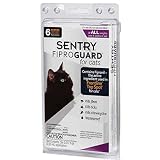
Cats can also benefit from the ingredients found in Frontline alternatives. If your cat is an adult and over a certain minimum weight (usually 1.5 pounds) then the Fipronil dosage is usually the same. Sentry tends to have the best deal, per dosage, for cats.
Fipronil also bonds with the natural oils found in the cat's skin and is stored in the hair follicles to be released over time.
Most cats respond well to the Fipronil chemical and it can keep you cat flea-free for up to 3 months. If your cat goes outdoors, you may want to consider using the treatment every month.
How To Apply Topical Flea Medication
To apply topical flea medication, first read the package instructions or consult your vet for guidelines. Some medications need to be administered all in one place and some should be dotted along the back in 3 or 4 places.
If the topical is to be administered in one place:
- Part the hair at the back of the neck, in an area your pet can't lick.
- Make sure you can see the pet's skin.
- Squeeze all the contents directly on the skin, trying to get as little as possible on the fur.
- Discard the container and wash your hands
- Monitor your pet for any adverse reaction and contact your vet if they develop vomiting or lethargy.
How To Apply Any Topical Fipronil
If the topical is to be administered in more than one place:
- Make sure you pet is calm and still.
- Start at the base of the neck and part the fur, exposing the skin.
- Squeeze a small amount of the medication in the spot.
- Move 4 to 6 inches down the spine, part the fur and repeat.
- Continue for the amount of application sites recommend on the package (usually 3 to 4)
- Discard the container and wash your hands.
- Monitor for your pet for any kind of reaction and contact your vet with concerns.
Other Considerations
As with any flea medication, Fipronil is a toxin that is meant to control pests such as fleas and ticks. Although most animals are not bothered by the chemical, it is important to figure out what works for your individual pet and its needs.
If you have been treating your pet for years with Frontline or other Fipronil products and begin to have problems with fleas, you may need to switch medications for six months to a year.
According to a 2008 study by Jill Maddison and Stephen Page, some fleas can develop a resistance to Fipronil over time. By alternating medications you can help to eliminate the ability of the insect to adapt and resist.
You can also add an oral medication such as Comfortis to boost the power and combat the fleas with two different products at once.
As always, ask your vet about the right treatment plan.
How Does Fipronil Work?
Once Fipronil is ingested, it goes to work on the nervous systems of insects, targeting a chemical structure and glutamate-gated chloride receptors, something that mammals don't have (Wikipedia, Fipronil).
Because the chemical is slow-acting, insects can infect their nests and lairs as well (a consideration when treating an insect such as a cockroach).
According to drsfostersmith.com, Fipronil targets adult fleas, basically speeding up their nervous system before killing them. So if you are treating a pet that already has fleas, you may see the fleas running around at high speed on your pet before dying.
It is important to remember that Fipronil does not target eggs or larva so, if you already have fleas, it may take several weeks for your pet to become completely flea free as the chemical targets them once they become adults.
What About Natural Alternatives?
Just as the market of natural products for people has exploded in the past few years, so has the market for pet products and alternative flea medications for cats and dogs.
Some have had good luck with products such as Diatomaceous (diametrious) Earth products which is a natural product that is toxic to insects but harmless to pets.
This product is usually fed to the animal or sprinkled in areas where there are flea infestations.
While with any product, you should consult your vet, my experience has been that this may work well in cooler climates or those that are not heavily infested.
People in humid and hot climates may have a harder time controlling fleas with just natural alternatives but it may be something viable to try if that is what you are interested in.
Other Natural Alternatives
According to PETA there are other natural alternatives you can try such as:
- Black Walnut
- Natural Flea treats with Vitamin B
- Sodium Borate
- Daily Flea Combing
- Herbal Shampoos
- Vacuuming and Washing of Pet Bedding
Even if you need to use topicals to get you flea population under control, you can try the natural alternatives during lower flea infestation times or after the flea problem is under control.
Find What Works For Your Pet
If you are looking for a good alternative flea treatment at an affordable price for you cat or dog, the Fipronil Frontline alternatives may be a good choice.
But remember that each pet is different and each pet needs its own health plan. While we all want to save money while keeping our pets healthy, we need to make sure that we are using the best flea treatment plant for them.
Just a few years ago, there were no effective flea treatments for pets that did not cost well over fifty dollars for even a three dose box.
Thanks to patents expiring, good flea prevention and care is well within many different pet owners' reach and budgets.
What kind of flea product do you choose for your pet(s).
5 Ways to Get Rid of Fleas Without Chemicals
Comfortis Flea Pills for Dogs: Better Than Lufenuron
Why is Dog Flea Treatment not Working?
by Adrienne Janet Farricelli 10
How to Get Rid of Dog's Fleas Using Soap Massage Treatment
The Seven Best Dog Breeds for Someone Who Works All Day
Causes of Limping in Dogs
by Adrienne Janet Farricelli 273
10 Most Aggressive Dog Breeds: Temperament Ratings and Information
by Sheila Brown 133
L C David 11 months ago from Florida
I don't think it does. I think it can help to deworm. To kill fleas on your pet it would need to be sprinkled on them for a period of time as well as in their bedding, etc. It is safe for your dog to eat but won't de-flea just by eating.

How does DE kill fleas in you feed it to your pet? It doesn't make biting them taste bad so I don't understand.
L C David 3 years ago from Florida
Yes, sometimes it is good to switch up flea meds just to help fight resistance. Hope you find something that works for your cat and keeps her flea free!
Diana Grant 3 years ago from United Kingdom
My vet has recently told me not to use Frontline, as fleas were becoming resistant to it, and my cat had spots on her skin, which were caused by an allergy to fleas. An injection cured that, and she is now on a stronger medication for fleas, but, being on prescription, it's very expensive. So it does seem, from your article, that if I use the strong one for six months until it's finished, I can then go back to Frontline
L C David 3 years ago from Florida
I have an article all about Comforts for cats. It is a great alternative for those looking for a prescription flea med that is not topical.
I have tried revolution on my cat each month. However the flea part runs out before the rest of product and my cat has gone nuts itching. When confortis came out I swore by it so when my vet suggested trying it with my cat I was all for it. Now I have a happy kitty who gets combed out regularly and I have been using natural ways to control fleas in home an itch free kitty is a happy kitty
Rose Clearfield 3 years ago from Milwaukee, Wisconsin
Good to know! I haven't had to combat fleas in this house (I shouldn't say that too loudly), but it's good to have some affordable options in case I ever do. Thanks!
Ann1Az2 3 years ago from Orange, Texas
No, I haven't tried it, but I think Walmart has it. If not, I'll have to order it online. I may try it next. I did try nematodes one time and they worked for awhile, but once the ground dried out, they stopped working.
L C David 3 years ago from Florida
Ann1Az2, have you tried the Diatomaceous Earth I mention near the end of my article? I have some friends who swear by it. Thanks for mentioning some more methods and ideas for flea control.
Ann1Az2 3 years ago from Orange, Texas
I was using Revolution on my cats, but I didn't like their reaction to it. One of my cats was sort of lethargic for a day or so, not bad, but I didn't like it. So I stopped using pesticides and went to natural stuff. I sprinkled cedar chips around my mobile home and in my flower beds. I also used them under the cat's bedding (in a pillowcase where they can't get to it - it's Velcroed together). Last year I soaked lemons in water overnight which forms a really great lemon water that helped repel the fleas. And it had an added benefit - it got rid of the lice that was on one of my cats. It also makes their hair soft. Since cats do a lot of licking, I made sure I put plenty of it under their ears and on top of their neck where they can't reach. That way, I only had to reapply it about every 2 or 3 days.
I also brush my cats daily and use a flea comb. I also wipe down the surfaces where they lay all the time (not their beds) with a mixture of water and Clorox, and I mop the floor with it, too.
I live in southeast Texas, so it's important to note that all of this doesn't completely eliminate the fleas, but it does keep them down to a minimum and my cats aren't constantly scratching. It also helps that I don't have carpet. My cats don't go outside, but neighbors' cats and dogs bring the fleas into my yard and then I track them in. That's why I try to keep cedar around the door ways outside.
Sorry for going on so long - I really did enjoy your hub! And Frontline is a good product. In some cases, it's the only thing that works.
L C David 3 years ago from Florida
Definitely important to figure out what works for your individual pets. My first Siamese lost all his hair when I gave him Revolution so it really is dependent on the cats. I found he could only tolerate Advantage II.
Shauna L Bowling 3 years ago from Central Florida
I hear you. I tried to go the cheap route and one of my longhairs has lost half her hair. She's obviously allergic to fleas. I've got them back on the Revolution and her hair is now starting to grow back.
L C David 3 years ago from Florida
Yes. In Florida preventing mosquitoes really does make sense. I wish it wasn't so expensive though.
Shauna L Bowling 3 years ago from Central Florida
Interesting info. I use Revolution on my cats. It also combats mosquitoes, which can cause heart-worm. It's expensive, but works better than anything else I've tried. It can only be obtained thru your vet because it requires a script.
Copyright © 2018 HubPages Inc. and respective owners. Other product and company names shown may be trademarks of their respective owners. HubPages ® is a registered Service Mark of HubPages, Inc. HubPages and Hubbers (authors) may earn revenue on this page based on affiliate relationships and advertisements with partners including Amazon, Google, and others.
Connect with us
Copyright © 2018 HubPages Inc. and respective owners.
FRONTLINE COMBO VET
SÅDAN VIRKER DET

Flåten påvirkes kun af fipronil og optager stoffet passivt, når den sidder i dyrets pels. Når flåten har optaget en tilstrækkelig høj dosis af fipronil, dør den, som regel inden for 48 timer efter kontakt med stoffet. Efter behandling er hunde beskyttet mod flåter i op til 4 uger og katte i op til 2 uger.
Loppen optager fipronil på samme måde som flåten, men dør allerede inden for 24 timer efter kontakt med stoffet. (S)-methopren forhindrer desuden loppens larver og æg i at udvikle sig til nye lopper. Efter behandlingen er hunde beskyttet mod lopper i op til 8 uger og katte i op til 4 uger.
Frontline Combo Vet er godkendt til brug på drægtige og diegivende hunde og katte. Midlet kan bruges på hvalpe og killinger, fra de er 8 uger gamle. Killinger bør veje mindst 1 kg og hvalpe mindst 2 kg. Midlet er specielt udviklet til katte og hunde og bør ikke anvendes på andre dyr. NB! Frontline må ikke bruges på kaniner.
- Brug ikke Frontline på en våd pels. Det gør det sværere for midlet at fæstne sig. For at opnå optimal effekt bør dyret ikke udsættes for vand de første 48 timer efter behandlingen.
- Vask hænderne grundigt efter behandling.
- Påfør Frontline et sted, hvor dyret ikke kan nå at slikke sig.
- Påfør Frontline om aftenen, så midlet kan tørre i løbet af natten.
- For at opnå vedvarende effekt bør behandlingen gentages hver 4. uge.
- Undgå kontakt med dyret, indtil påføringsstedet er tørt.
SÅDAN BEHANDLER DU
- Alle hunde og katte i huset skal behandles.
- Frontline Comp må ikke masseres ind i pelsen.
- Ved behandling af lopper: Vask alle tæpper og puder, som dyret har været i kontakt med, ved 60 grader.
- Ved behandling af lopper: Gør grundigt rent – også i bilen.
- Husk at tømme støvsugerposen bagefter.
250 ml flaske: 2-4 pumpeslag/kg afhængig af pelsens længde
250 ml flaske: 2-4 pumpeslag/kg afhængig af pelsens længde
SE ENDVIDERE BRUGSANVISNING PÅ PAKNINGEN
Efficacy of fipronil in the treatment of feline cheyletiellosis
The purpose of the present study was to confirm the efficacy of 10% (w/v) fipronil spot-on (Frontline ® spot-on for cats) in the treatment of feline cheyletiellosis under field conditions. A total of 16 cats of different breeds, sexes, 4 months to 14 years of age and weighing 0.5–6 kg were treated with a single topical application of 10% (w/v) fipronil spot-on according to label directions. The animals were naturally infested with Cheyletiella mites and housed in their normal environment throughout the study. Animals were selected based on clinical signs and infestation was confirmed by demonstration of mites. Mite counts and a clinical assessment of mite infestations (i.e. skin lesions and/or scales) were performed on days 0 and approximately days 14 and 28. Individual counts on day 0 ranged from 1 to 40 mites on individual animals. No mites were detected on cats treated with 10% (w/v) fipronil spot-on (Frontline ® spot-on for cats) at both post-treatment evaluations. Typical skin lesions and/or scales were present in all animals pre-treatment. In 56% of the cats, the lesions resolved within 14 days after treatment. At the final assessment, 75% cats were free of lesions. Two cats that still had clinical signs on day 28 were suspected of having allergic reactions to food or environmental allergens. The lesions on the remaining two cats could not be related to a specific cause. The efficacy of fipronil in elimination of mites was 100% on each occasion when compared to the pre-treatment count. The results of this study demonstrated that fipronil in a topical formulation is highly effective (100%) for the elimination of an existing Cheyletiella mite infestation under field conditions following a single topical application in cats.
Choose an option to locate/access this article:
Check if you have access through your login credentials or your institution.
Merial Frontline Plus 3 Pack For Dogs Under 22 lb
_6.JPG" /> 
 Архивная фотография
Новые: самая низкая цена
1 416,82 руб
- См. подробные сведения о расчетном времени доставки
- • Состояние: Новый
- • Возврат товаров принимается - 30 дн. возврат средств или обмен товара
Все объявления по этому товару
товар 1 Merial Frontline Plus 3 Pack For Dogs Under 22 lb Orange FAST FREE SHIPPING - Merial Frontline Plus 3 Pack For Dogs Under 22 lb Orange FAST FREE SHIPPING
товар 2 Merial Frontline Plus Flea & Tick Control for Small Dogs 5-22 lbs for 3 Month - Merial Frontline Plus Flea & Tick Control for Small Dogs 5-22 lbs for 3 Month
товар 3 Merial Frontline Plus 3 Pack For Dogs Under 22 lb - Merial Frontline Plus 3 Pack For Dogs Under 22 lb
товар 4 Frontline Plus 3 Pack For Dogs 23-44 lbs Blue FAST FREE SAME DAY SHIPPING - Frontline Plus 3 Pack For Dogs 23-44 lbs Blue FAST FREE SAME DAY SHIPPING
Пользователи, купившие этот товар, также приобрели
Cat Flea & Tick Remedies
Текущий слайд
2 Boxes Pet Armor Plus for Cats Kills Fleas Ticks - 6 Month Supply PetArmor
Трендовая цена
- Новые 902,18 RUB
- Б/у: ----
Bayer Advantage II Flea & Lice Control for Small Cats 5-9lbs
Трендовая цена
- Новые 1 812,87 RUB
- Б/у: ----
Об этом товаре
Description
- Playing outside with Fido should be fun for everyone, especially the dog. When nature's pests attack your canine's sensitive skin, you may want to do whatever it takes to help your best friend. You can protect your small dog from the potential dangers of flea and tick bites with the Merial Frontline Plus 3 Pack. Fleas and ticks have long been a menace to dogs, especially during the summer months. Yet, insects do survive during cooler months when your pet is typically indoors for more extended periods. These pests can even pose serious health risks to your pet by transmitting diseases, such as Lyme disease. For this reason, it can be necessary to take action quickly to control and treat flea infestations as soon as they’re noticed. Frontline Plus can be a convenient and effective treatment applied directly to the animal's skin in one spot. The treatment can kill any fleas and ticks on your dogs and prevent new ones from latching onto them. The treatment can work on parasites of all life stages, including eggs. Since a flea or tick is not always easy to spot, especially on a long haired dog, preventative treatment can be the best way to remain vigilant against these parasites. Frontline Plus can rapidly treat chewing lice, which suck the blood from dogs and can leave your pet with bald spots or lesions. Direct treatment to skin all year long can be the best way to prevent infestations from coming back. A three-pack can supply enough medication to keep a single dog protected from fleas for three months. While this product is tough on ticks and fleas, it can be gentle on dogs. The treatment can even be safe to use on dogs that are pregnant or nursing. Within 12 hours after treatment, applied every month, your dog's flea problem can be under control. And since it is waterproof, your dog can still enjoy going for a swim or bath 24 hours after application. Frontline Plus is a broad-spectrum insecticide containing the active ingredients fipronil (9.5%) and methoprene (8.8%) for use on lightweight dogs and puppies that weigh under 22 lbs. Fipronil disrupts the parasite's central nervous system, causing paralysis and death, but it is completely safe for pets. Methoprene inhibits the growth of eggs and larvae, preventing further infestation. The combination of the two types of insecticides is termed 'integrated flea control' and targets both stages of the parasite's life cycle. The adulticide kills active fleas, and the insect growth regulator will destroy any larvae on your pet and those left around your home. You can feel confident that your four legged friend is protected from pests at home or in the park. You don’t have to worry about your dog picking up parasites at a crowded obedience class or on a hiking trail. Dog owners care for their pets with careful consideration of pet food, toys, treats, and other supplies. You don't have to neglect this important treatment for the health and happiness of your pets. With regular treatments, you can have peace of mind knowing your dog is protected with the help of Frontline's medication.
Product Identifiers
Product Details
Measurement
Оценки и отзывы
Наиболее подходящие отзывы
Frontline Plus For Dogs
I have been using Frontline Plus on my dog for several years. It is easy to apply and doesn't cause my dog any discomfort. I have never seen any signs of fleas on my dog since using this product. I recommend Frontline flea prevention to anyone who has cats and dogs.
Проверенная покупка: да | Состояние товара: Новые
It's not foolproof but helps
Frontline is not a foolproof solution but it helped noticeably. If your animal has fleas this should knock em down considerably along with a good bath once a week or so.
Проверенная покупка: да | Состояние товара: Новые
Do Not Recommend
This product did not work for my dog AT ALL. I gave it a few days hoping it was just taking a little bit to work, but since I've used the product (which has been 3 weeks ago that I applied it), he still has tons of fleas. After a week, I gave him a bath and the flea population seemed to be less, but within the following 2 weeks, they just increased back to where they were before the treatment. I feel really disappointed as I was hoping for my dog to be flea free!
Проверенная покупка: да | Состояние товара: Новые
They STOPPED the constant scratching.
So far having great success with this and it's better than having to "drip" the product from neck to tail and leaving the whole back with a streak of medication. Our little guys ceased scratching by the next day. I purchased six months worth and plan to make it a regular application every month.
Проверенная покупка: да | Состояние товара: Новые
Only kind we have ever used. It's easy to use and have never seen a flea or any type of creepy crawlers. We have three dogs.
Проверенная покупка: да | Состояние товара: Новые
Ознакомьтесь с руководствами для покупателей
Текущий слайд
5 Reasons to Choose Frontline for Your Dog
Наиболее популярные в Средства от блох и клещей
Трендовая цена основана на ценах за последние 90 дней.
Текущий слайд
FRONTLINE Plus For Dogs 45 - 88 lbs lb 1408 fl oz
- Новые 1 412,28 RUB
- Б/у: ----
Bayer Seresto Flea and Tick Collar for Large Dogs - 8 Month Protection
- Новые 2 663,98 RUB
- Б/у: ----
FRONTLINE Plus Flea and Tick Control for 5-22lbs Dogs - 3 Doses
- Новые 1 245,46 RUB
- Б/у: ----
Merial FRONTLINE Plus Flea and Tick Control for Dog 20-40kg 3 Doses Ship
- Новые 2 804,70 RUB
- Б/у: ----
Bayer K9 Advantix II 6 Pack for Large Dogs 21 - 55 Lbs
- Новые 2 262,82 RUB
- Б/у: ----
Bayer K9 Advantix II Large For Dogs 21 - 55 lbs lb 880 fl oz
- Новые 1 985,93 RUB
- Б/у: ----
Merial Frontline Plus For Dogs 45 - 88 lb 0.2 fl oz
- Новые 1 418,52 RUB
- Б/у: ----
Получите скидку на Средства от блох и клещей
Трендовая цена основана на ценах за последние 90 дней.
Текущий слайд
Frontline Plus Flea and Tick Control for Dogs and Puppies 8 weeks or older, 45 t
Merial Frontline Plus Flea & Tick Control for XL Dogs 89-132 lbs for 3 Month EPA
Frontline Plus for Dogs Flea and Tick 45-88 Lbs 3 Dose Pak Genuine EPA Product
Advantage II for Extra Large Dogs Over 55 lbs, 6 Month Supply USA EPA APPROVED
Merial Frontline PLUS Blue For Dogs 23 - 44 lb( 3 dose)
Frontline Plus for Small Dogs 5 to 22 lbs 3 Doses EPA approved free shipping
Вам также могут понравиться
Текущий слайд
Examining insecticides afoxolaner and fluralaner as used in flea and tick preventatives


I saw ads for a new flea and tick insecticide on Hulu recently, and was curious about the ingredient they were using. The following post outlines the research I did on the product, and a related one I found during research.
About the product
The makers of Frontline have created a new chewable product called NexGard that can be used to repel fleas and ticks. It is similar to another product called Bravecto, also a chewable designed by another company also used to repel fleas and ticks. Both products contain a chemical derivative of isoxazolines, which are derivatives of isoxazole. All are part of the same chemical group the better-known insecticide fipronil comes from.
About the ingredients of this flea and tick preventative
The active ingredient in the flea and tick product NexGard is called afoxolaner, and the active ingredient in Bravecto is called fluralaner. They are similar chemicals, as noted above. Afoxolaner states the following efficacy:
Fleas and ticks must attach to the host and commence feeding in order to be exposed to the active substance. For fleas ( C. felis), the onset of effect (death, >95%) is within 8 hours of attachment. For ticks, the onset of effect (>90%) is within 48 hours of attachment. (Source)
If you are concerned about some tick borne diseases that may be transferred in less than 48 hours, you may want to consider other forms of repellants. This product is also not recommended for dogs who have a history of seizures, and recommends consulting a veterinarian before using with breeding, pregnant or lactating dogs. The study that demonstrated the efficacy of the product was funded by the manufacturer, something to consider in the decision making process. In other words, you may want to consider anecdotal evidence as well.
Safety of afoxolaner and fluralaner
Unfortunately, there is very little information on these drugs. Afoxolaner was recently approved in 2013, and most of the information available online points back to a study that was sponsored by Merial who patented the drug. Not only was the trial done on dogs with afoxolaner run by the manufacturer (Merial), but the trial done for Bravecto was performed by employees of Merck who sell it. Because both studies were conducted or sponsored by the companies that had vested monetary gains by them producing a positive result, I do feel that either are worthy of close study or consideration.
This, of course, is my opinion only. I do not have a lot of trust in large corporations paying for their own safety studies in order to bring a new drug to market – of which there is significant monetary gain as described here: “Under section 512(c)(2)(F)(i) of the Federal Food, Drug, and Cosmetic Act, this approval qualifies for FIVE years of marketing exclusivity beginning on the date of the approval because no active ingredient of the new animal drug has previously been approved.” (Source). Essentially, generics can be made after patents expire and this means that such companies create new products that only they can sell. Companies need to keep patenting new drugs to have this market advantage.
But what we do know is afoxolaner (NexGard) and fluralaner (Bravecto) are both part of the isoxazoline chemical class. They are commonly used against parasites, and is in the same group of chemicals as Fipronil that is widely known and understood to be a carcinogen. Chemicals in general can lead to suppressed immune systems, and suppressed immune systems can directly lead to problems like immune-mediated disease and cancer. In other words, it’s best to proceed with great caution when approaching unknown chemicals.
I do agree with the veterinarian who states in this article:
Consumers in general, and the pet-owning public in particular, need to be more mindful and questioning rather than trusting what they are told by manufacturers and our government regulatory authorities.
Because afoxolaner is part of the same class of chemicals as fipronil, and has not been independently or widely studied or on the market for long, I personally believe that great caution should be used before putting this chemical into your dog’s bloodstream.
In summary
Unfortunately I wish there was more concrete evidence that I could point you to about these products. They are new, and the only science I can find in relation to their efficacy and safety comes from, what I personally feel, is a highly conflicted source. Therefore, I can only present that the chemical is related to one that is known to be dangerous, but I can’t say with any certainty it is dangerous as well through related (unbiased) study or anecdotal evidence as the product is so new.
I do invite you to weigh in your own concerns, or share any anecdotal evidence you have experienced or found. I don’t doubt that the product could be quite effective, but I always do caution people to carefully consider the long-term risks of any chemical – especially new ones that have yet to prove themselves – that is used regularly and directly enters the bloodstream and can suppress the immune system or cause issues that we just don’t know about yet.
UPDATE: There are two very active groups on Facebook about these two drugs. There are regular postings added about dogs who are experiencing similar and severe side effects not long after taking these drugs, suggesting there may be a link between the two. Do remember that this is anecdotal evidence, but it can be useful to help arrive at a decision provided the limited studies and limited time the drug has had on the market.
Note: I am not a veterinarian. Please consult a trusted professional before administering any of these or similar drugs to your dog. If you are not sure, ideally seek a vet without vested interest in a related purchase.
About Author
Jen deHaan is graphic designer, small business owner, and dog person living in Bay Area, California. Jen enjoys learning about dog training and behavior, and has taken several courses and seminars since 2010. She also contributes articles to leading websites, such as Victoria Stilwell's Positively . It all started with a great dog called Mikey (aka "dude"), loved and lost but remembered forever. Jen also runs a freelance business focusing on graphic, web, and UI design at FoundPixel, and a small business creating hand crafted dog products at Stylish Canine.
Related Posts

Petcube Play Review: interactive wi-fi camera to put our dogs on surveillance

Natural remedy for dog diarrhea: slippery elm

My dogs have it way too plush, look at this giant-a** dog bed.
I just suffered a loss of my beloved bearded collie at the hands for Bravecto. Bravecto is a KILLER! DO NOT GIVE to your dogs! I had a 4 year old bearded collie that went to the vet on Wednesday 6/3/15 was GIVEN A CLEAN BILL OF HEALTH, prescribed Bravecto and then died less that 24 hours later after taking it! He started to cry out and then collapsed, one of my sons started cpr on him and he was rushed to an emergency clinic only to be pronounced dead shortly after his arrival. Please, please, please DO NOT GIVE BRAVECTO IT IS A KILLER.
Patti, I am so so sorry for your loss! I just saw what I believe to see your story (Duncan?) on Facebook. Thank you SO much for getting the word out about what happened – it is sure to help others make a good decision for their dogs, and you could be saving many lives in the process.
My hugs to you. Sudden losses are absolutely one of the worst possible things to experience. Know that my thoughts are with you at this time.
I just got a dog from the vet I go to that was rescued from a very abusive home and he is very malnourished. They gave him Bravecto yesterday and today he has had diarrhea 7x and is lethargic. Is there anything I can do to counteract this? Please help.
Well too bad I just found this article. I went to the vet this morning for my Blue Merle had developed hot spots and was biting herself raw on the hind end. I asked for Temeril-P and the clerk gave me this sales pitch o Bravecto. $52.00 dollars US and lasts for 3 months. I gave it to her as soon as I got in the car. I get home and start reading about it and find that it is new, and at least 28 Beagles died that were 9months old from their form of testing. They fed 8 week old Beagle puppies this Fluralaner for 6 months and afterwards they euthanized them and did post mortem studies.
First of all, why was it necessary to euthanize these pups? 2nd of all, 9 months is hardly to see what the chemical does to the dogs long term, as in cancer.
The clerk did NOT tell me to offer it with food either, so my Aussie got this on an empty stomach. You can bet I will go back with this information to the vets office, my dog will not receive another dose of it ever. Tomorrow I will be on my way to the Holistic store to find a detox herb for my Aussie.
Thank you for this article.
What a tremendous thing you did looking into it though, despite a dose. I too bought Trifexis after a pitch a few years ago. I was inches away from giving it to the dogs, then realized I should maybe read into it more (this was back when I recalled reading it was “so safe”). Dug into it a little, and started hearing the horror stories. Many more of them now…
It’s such a scary world we’re in where our dogs are the scientific study never run for long-term safety. Efficacy – sure. But safety doesn’t seem to be part of any study run before these drugs become FDA approved. Then the long term you mention… nothing at all. Is anything run about bioaccumulation? How it affects the immune system over time? What it may trigger or influence? Considering the related Fipronil is a “slow acting poison” do we even know how fast or slow these chewables may poison?
Anyway – best of luck at the Holistic store and for the detox. Look into Chlorella – they have dog versions, but you may prefer human “Clean Chlorella” (it’s produced in Korea in indoor tanks, which reduces contaminants). Anyway, it’s quite proficient in detox for humans and I’ve been reading into use on pets where it’s also safe.
Take care and wags to your Blue Merle.
Thank you for your kind response. I started cooking for them last Sunday, It does not cost that much to buy organic. If you have any recipes to share I would be grateful. I started with organic chicken, sweet potato, broccoli, rolled oats, flax oil and eggs.
Fantastic!! I’ll paste the home cooked recipe we received from our holistic vet years ago. (Right now the dogs have a raw grind diet that’s mostly meat/organ/bone ground in with herbs and garlic).
The one thing we noticed is one of our dogs does a little better without sweet potato, which can sometimes make them itchy I read. Only some dogs though.
40 lb dog, per day.
10 oz of meat (10% organ meat)
10 oz of cooked mixed vegetables, esp leafy greens
5 oz of either rice, barley, oats, sweet potatoes
1.5 tsp of olive oil
0.4 tsp salt substitute (ie: No Salt)
Add daily (per directions):
carrots, green beans, peas, romaine
(smaller %) spinach, broccolli, red pepper, celery, banana, apple, blueberry
Others healthy things you can add:
Boiled eggs or even raw egg
Note: it’s important to change up the ingredients (different proteins, different vegetables), it’s good for the dog both mentally and physically.
Vegetables should be steamed and run through the food processor so they are easier to digest. We ended up getting a huge steamer and food processor to help with this.
Hope this helps! There are a ton of options out there. The main things to watch for are calcium (as it’s so vital), and be cautious not to focus too much on one veg (ie: some are not good in larger quantities, like broccoli or spinach).
My dogs love Chobani plain yogurt and Almond milk, are these sufficient calcium? What are you using for salt, and I heard kelp was good for them in small does too.
I’m not too sure about the amount of calcium in yogurt/almond milk – we were adding it manually in the above recipe (in their raw grind they get it through bones). You could get calcium for dogs and just mix it in to ensure the proper amount is consumed, it’s very inexpensive. And you can of course still provide the yogurt. One thing to watch in yogurt are hormones etc. since dairy comes from pregnant cows (sigh, this stuff gets so complex).
Our vet’s diet included the No Salt, but not regular salt. We did however provide a multivitamin that had the required daily nutrients (this was years ago, I forget which one we used). Dogs need very little sodium and can get it from other sources too (there is often an excess in treats, including many human foods commonly given as treats, etc). If you don’t use a daily multivitamin you may want to consult with a vet about the exact supplements you will want to provide.
I too have heard about kelp being fantastic. We’re just starting a bunch of new supplements (I’m adding them slowly) – next up for us are Turmeric/coconut oil, and Chlorella. After I may have to look into kelp :)
Thought I would pass this on to you for the pups, I found it at the Vitamin Shoppe for joint mobility with turmeric in it. Called Mobili-T by LifeSeasons: Collagen Type II, Glucosamine, Chondroitin, MSM,. Turmeric
I have a 2yr old Golden Retriever and we have battled fleas for three weeks now. He is itching himself constantly, causing black scabs all over, and I can see flea eggs on him. I have given him organic flea baths, dusted him and our home with Diatemaceous Earth, used Purification oil on him, as well as top grade cedar/lemongrass/lavender sprays on him and nothing is working. I vacuum daily, flea comb, and he is still miserable. I called two holistic vets in our area, Portland, OR, and both recommended Comfortis or Afoxolaner, being they use “organic pesticides, the same pesticide that veggies from farmer’s markets use” Literally, that is what they both told me! I broke because I was desperate and my pup was miserable and gave him Afoxolaner. Now I’m panicking. Can anyone give me pointers on what they are using for natural non-pesticide flea prevention? Our area is humid and hot and this summer is supposeed to be off the charts heat-wise.
I think one of the issues is that the pesticides are also quite controversial in organic food circles too!
I’m so sorry about the shock – try not to panic too much, because I always feel it’s better to know about something sooner rather than years and years later you know? Regardless, there are other things you can try. Here are a few ideas for you to look into.
1) Food. The first and foremost thing to consider is diet, I feel. There is a lot of evidence around raw and/or home-cooked meals greatly influencing (reducing) pests. Has many other benefits, including related ones, like supporting a strong immune system that’s very important for all aspects of health. If finances are a concern, look to meat co-ops or even local hunters who have game to sell. It’s amazing what’s around if you dig a little, and it can almost become a cheap way to feed a dog.
2) Garlic and brewers yeast. Very inexpensive (I use BugOff garlic for dogs from Springtime and Brewers yeast from Amazon – but there are many, many options), and can be combined with food.
3) “Tags” like ShooTag or related ones. I’m trying a new one from Only Natural Pet tomorrow. I’ve had anecdotal success with them. No claims to understand the science, and it could be coincidence, but I have had personally seen two cases in my own house where I’ve had fleas on the pets and added the tags and no fleas on them later in the week that lasted for months (my cat doesn’t get raw/homecooked due to IBD so she needs tags for sure). I was recommended these tags from a pet store that reports many customers swearing by them – was kind of surprised to see any result, but hey. No chemicals. I use them during flea season.
4) Try other sprays, such as CedarCide (I just ordered based on reviews – haven’t tried it yet). Can help with fleas around the house, and apparently safe to use directly on pets. You may need to find the right one based on your dog and what you feed.
And of course, with all of these keep up with the regular washing and DE or cedar sprays can help. When going chemical free, I do believe a holistic (ie: diet and supplement being of utmost importance, spray, washing, tags etc to aid) approach really helps – and although it is certainly more work, the payoff is a healthier dog without needing to worry about long-term chemical use.
For all of the above, remember it takes some time for the body to adjust and if using tags it takes at least a few days to take affect (apparently). Relying on the food for help can take a bit longer to let the body shed any toxins from the food and strengthen the immune system and so forth (basically, become the kind of body a flea doesn’t enjoy hanging around on).
None of those non-pesticide flee control alternates work. And urban fleas are becoming immune to the topical pesticide treatments. Try the once a month pill. For me, it works well. I have given it in combination with heart worm preventative and round worm preventative.
“None of those non-pesticide flee control alternates work.” That is simply not true as a blanket statement. The protocol I listed below does not involve pesticides, and has kept fleas and ticks off my dogs for over 4 years and possibly mosquitos (as their heartworm tests have all returned negative). I am 100% sure they have been around tons of fleas and at least a moderate to high level of ticks when we’ve been hiking, and they do not have any on them. My friends dogs have returned from the same hiking trips with many ticks. A pesticide free protocol does involve a multi-faceted approach and diligence, but it is certainly possible and DOES work in at least my experience over the years with the dogs I have. I have spoken with many others in other regions that it has worked for as well (also with a high flea/tick environment – hot, humid, standing water etc). Not to mention, all of those chemicals depress the immune system which is the first line of defense against cancer and many other serious diseases. Oh, not to mention – heartworms.
If they work for you, that is great.
It is! And that’s why I write, to provide alternative options to try before resorting to more dangerous ones :) I myself never knew about what the options are before researching a lot, as every vet I’ve had pushed me toward poison.
Hi, my sister’s vet in Erin , Ontario just recommended both Revolution and Bravecto for her 11 year old Lab for ticks. After I read the study that was done in Ireland for the drug company and a few horror stories( not necessarily substantiated) I would not feel safe in using it. I have a large Airedale and we now have ticks in our area. If these chemicals are safe for dogs, why are they not recommended for people who are susceptible to Lyme disease? Makes you wonder doesn’t it?
Absolutely. I’ve always wanted to respond to those who say “sometimes you just need chemicals” to ask why they don’t put a top spot or chemical collar on a baby when hiking in the woods then…
My first vet recommended Frontline just because my dog was itching – no fleas (I told him that too, thoroughly checked and watched for fleas all week). Didn’t suggest looking into allergies or skin problems, just recommended Frontline over the phone no exam :( I was a new dog person, and didn’t know any better, so unfortunately I followed his advice.
Urban fleas are becoming immune to Frontline, and it’s other competitors.
You say that you have ‘unfortunately’ followed your vet’s advice by using Frontline. Were there any adverse reaction? I have to know, because that is what I have bought to put on my pup. I have not yet had any problems with Frontline spray with any dog, but have also not used the spot on version because I do not trust it. I have bought the spray again, but if there is any chance that my pup will react to it, then I’m throwing it away!
Yes, it’s probable I ran into side effects with the drug – but side effects (and serious ones) are very common with Frontline in general. My dog died from IMHA (he was on Frontline and Heartgard, and we ruled out other possible causes of the disease), and although I cannot make a direct scientific link there is a lot of anecdotal evidence in the IMHA community that links the two. And for that reason, and many others, I avoid all flea and tick pesticides in my dogs’ blood streams. I encourage you to read into Frontline reactions online from other dog owners. Note that Frontline is in the same class of drugs as Bravecto (basically a small chemical derivative to form the drug, I suspect for patent reasons).
There is a spot on Facebook started by a holistic vet on bravecto and nexgard. A link to report side effects to the CDC as well.
I have linked a couple of the Facebook groups in the article, but very happy to link any others that are out there. Feel free to post the link here and I will add it to the article body. Thanks!!
I think those might be the ones I link in the article, but if not please feel free to add a link here. Thanks!
How does Fluralaner work? What was involved with the studies performed? These studies should be available for scrutiny, and reproducible. Understanding how the drug works is important, and known. This pesticide is active in the dog for three months, and has no ill effects on the dog? That is interesting, and worth more than a superficial review. There are people bitten by disease carrying fleas all over the world, why not give the drug to people?
Good question, but possibly more the case for ticks than fleas. If the tick borne diseases are so damaging to children (which they are), why don’t they develop a top-spot for babies? My hypothesis is that it – if like what are put on dogs – would never pass tests. Or, would need to be tested much more thoroughly than they do for dogs. We do need to understand the risks of these drugs in many, many more scenarios (dog ailments, mixed other drugs, breeds with certain genetic traits, etc) and for a longer period of time than these tests have been run. They need to look at how it affects the immune system. People’s pets shouldn’t be a science experiment. And since they are, it makes sense to share these anecdotes so people can make a better more informed decision before choosing to use these products – and I do hope that vets would also be encouraging this and diligent research before taking on a pesticide that their dog will have in their system for many years as part of a cocktail with other drugs/pesticides in their system for years.
Since posting I read some stuff from other sites. Fluralaner kills tickets in 48 hours. 48 hours is the minimum time estimate for a biting tick to transmit lyme disease. So it is unclear if this treatment prevents lymes or any other tick transmitted disease. By the time I find a tick on my dog, more than 48 hours have gone by. And I have had inconsistent results from various tick collars. If they get at all wet, they are useless. But fleas transmit diseases like plague and another bad one that slips my mind right now. People in poor countries, living in flea infested conditions, might benefit from the treatment, if it kills the fleas. The pesticide apparently kills mosquitoes as well, but has minimal application for obvious reasons. Dangerous to people? It needs testing. It is intriguing that Fluralaner can stay in the dog’s system for three months, with no observed affects. This is also a new generation of insecticide that was supposed to be used in agriculture first, but ended up being used in pets, first, instead. Unusual. The insecticide focuses on disrupting a specific metabolic system unique to insects. I expect to hear more about it’s expanded use moving ahead. It might take the place of organic phosphate insecticides in agriculture. I emphasis, might.
I actually do note that in the above article. However, I also note that there are some diseases that transfer in less than 48 hours, and this pesticide is not always effective in 48 hours. That’s why attacking the problem before those 48 hours have passed is way more effective. And yes, as mentioned in the above article and linked data sheets, certainly understand and have explained what these pesticides are intended to do. The problem I’m discussing is what they also do to the system, and how much is not known because it wasn’t studied. Look at the studies of drugs now known to be really dangerous, and how they were once considered “completely safe” because of short and incomplete studies and quickly released drugs for patent and profit reasons.
As also noted in the article and above comment, just as dangerous to dogs is the ongoing suppression of the immune system – this just one major contributor to the assault placed on it factoring in all the other things they (and we) are exposed to and/or eat. A suppressed immune system leads to cancers, auto-immune disorders, and a host of other ailments. Over half of ALL DOGS get tumors, and it’s the cause for over 50% of senior dog deaths. Over half. That’s why I consider these pesticides dangerous, and don’t doubt for a second they cause many of these problems.
I’m certain this stuff will be used more in the future like you say. Would be shocked if it wasn’t. After all, we can guess it’s primarily about profit before the patents expire.
Hi, I started a Facebook group called Does Bravecto Kill Dogs so people could come together and report side effects from this drug. The stories in less than two weeks are heartbreaking. Including myself, approximately seven stories of people that healthy dogs die within a short time of taking the medicine. And many other stories of horrible side effects. I urge you to check out the postings yourself and share this information any way you can. Thank you
Thank you for sharing the group Susan! I’m adding the link here so folks can find you quickly: https://www.facebook.com/groups/411371212394679. Please feel free to let folks know they can share their story here if they wish to do so publicly. Here is a link to a Nexgard group: https://www.facebook.com/groups/704330073037200/
11/2015: Center for Veterinary Medicine Adverse Drug Event Report, for Bravecto. 22 pages of adverse reactions including deaths: http://yourpetsneedthis.com/wp-content/uploads/2015/11/Bravecto-fluralaner-ADE-report.pdf
Thank you , I will not be giving my furbabies this drug, let them deal with the fleas and other preventive measures,
Hi, I live in South Africa and have or rather had 2 beautiful border collies until my local vet talked me into Bravecto. I lost my very healthy 3.5 year old male with a bout of diarrea followed by so called IMHA within the month. My boy who was very active and a great jumper started weakening in his back and was less eager to jump and walk. Only on reflection after his death did we realise it started just after taking the Bravecto.
My 4 year old girl is really struggling to walk and is also quite lethargic.
The 3 month period runs out at the end of Jan and I can’t wait to stop this madness. No more big drug companies or pesticides for us.
My neighbour’s dog has also started seizures after taking the drug.
This might all be coincidence but I am definitely not convinced.
I’m sorry for your loss. I’m not too sure if you saw my posts on IMHA on this site, but I also lost my dog to that disease. I do suspect either vaccine or preventatives as the trigger (he was on Frontline). You can find one of the posts here http://dogthusiast.com/2010/10/11/what-i-learned-from-losing-my-dog/ and the other here http://dogthusiast.com/2010/11/30/the-story-of-mikey-our-dude-for-celebrate-shelter-pets-day/. Not using these kinds of drugs and pesticides was also the first thing we did after experiencing that terrible, terrible disease which is believed to be triggered by them.
Have you reported Brenda and if you have not already done so please join our page and tell your story. I am worried that the MDR1 gene might be responsible for some deaths / reactions as the testing was VERY limited. Just 16 dogs and half got the Bravecto and half a placebo. I am unable to find any other testing mentioned than this one test!
Reporting in on another dog death. 1 year old healthy two year old, two months sucumed to Kidney Disease after Bravecto/FLURALANER. Other dog is showing increased levels on blood work up. Have a blood test done immediately if you have given your dog Bravecto.
To understand what you are giving your dog with these two drugs, you must understand the industry that manufactures them. Sadly, unethical, and unaccountable once adverse affects are reported in. Merck manufactures Bravecto’s ( fluralaner ). Sadly I did not know the history of this company, nor did I do my research on this drug. Out of three dogs, one has died, another blood work up affected, and one appears to be unaffected. The one that died was under two years of age. Snopes is not a good rebuff for the reports of deaths, for they simply have a vet who believes in this product give his opinion. Snopes has lost credibility with their listing of this as a hoax. From their Vioxx deaths, to now their MM vaccination fraud, gardasil vaccine, and the finasteride side effects men face, no one is safe… Not even our dogs. Do your history on this company before you rebuke the deaths as a hoax. Sigh. She’s gone… this is so real and unnecessary.
It is no longer just “anecdotal evidence”. We now have Freedom of information reports on the reports cases in the USA in the 19 months since Bravecto was released there. 5319 reports and 164 deaths for Bravecto. 7155 reports and I think it is at least 100 deaths for Nexgard.
The deaths and side effects after dogs have been prescribed the oral flea and tick chewable Bravecto is mounting. Now there are even reports of adverse reactions in humans. In the newest Center for Veterinary Medicine Adverse Drug Event Report for Bravecto released in 1/2016 there are 29 pages of adverse reactions including 106 new reported deaths on top of the 54 from the report that was published in 11/2015. The new 2016 report also includes adverse reactions reported in humans. Since awareness was first raised in June 2015 from a FB post that went viral and then again in Aug. 2015 when the group Does Bravecto Kill Dogs? was started there is a total of 5319 adverse reactions which include deaths in both of the CVM ADE reports, the first was released 11/2015 and the 2nd one 1/2016. Links are provided below.
The group Does Bravecto Kill Dogs? offers additional information, how to report any reactions or deaths along with stories from pet owners . There are vets and vet techs in the group as well as hollistic vets who provide safer alternatives and the group members offer support: http://www.facebook.com/groups/411371212394679/
Please feel free to share!
I can personally testify to the drug Bravecto being very dangerous to dogs. My brother’s 5 year old Labrador female was one of the most healthy dogs that I know. Never anything wrong with her. After receiving Bravecto for the first time in June 2015, she gradually began losing vision in both her eyes. The condition was not recognized as possibly being connected to Bravecto, and she received a second dose of Bravecto in September. She is now almost completely blind, and it was only after I warned my sister in law about Bravecto that she connected the blindness to Bravecto. Fortunately the warning came in time to stop their three dogs from receiving a third dose. As it is by now well known that the effects of Bravecto can be delayed for even longer than a year, I am hoping that the two Jack Russell Terriers will remain healthy and with no adverse reactions to fluralaner.
I am just thankful that I had decided to do some research after my FORMER vet tried to convince me to give this drug to my puppy, who was only 8 weeks old at the time. I refused to let her be subjected to a drug that I knew nothing about and told her I would reconsider and let her know when I take my pup for her 2nd vaccination. During research I typed in “Bravecto” in the Facebook search field, and found both the group “Does Bravecto Kill Dogs?” & “Does Nexgard kill dogs”. Needless to say, I have decided to fire my vet and NOT use Bravecto for my pup. My decision to change vets may seem a bit harsh to most people, but the reason was not that she tried to sell me the drug, but the manner in which she actually tried to bulldoze me into buying it, even though she knew that my pup doesn’t get into contact with ticks and doesn’t have a flea problem…
Jen, you did a great job on this article! It is simply stated and gets the point out. I too, can attest to nexgard. We lost Gretchen, our Mini Dachshund, a few months after giving it to her. On the coattails, of Does Bravecto Kill Dogs, I started Does Nexgard Kill Dogs. Knowing what I know now, I can’t help but think if my VET was more educated and open minded to Gretchen’s symptoms, perhaps she would still be here. Vets are recommending these drugs and insisting they are the best – without doing their own research. Gretchen had ALL the side effects that are noted on the side of the box and STILL he dismissed the notion of having anything to do with nexgard ( I can’t give the drug the respect of capitalizing the first letter). VETS need to be more educated and stop taking the word of a ” sales-rep”….a sales rep…Really??
So sorry for the loss of your dog Jeni. My Joey has been on Nexgard during the flea season last year and this and I noticed no side effects except a bit of itching but not excessively. I will certainly be trying Spinosad instead. He’s a 17 month old Cocker Spaniel and he means the world to me and our old Golden Retriever gal Lily.
My dog had a massive reaction to Bravecto – he had vomiting and diarrhoea. Simply the 12week effectiveness may seem appealing but you have to wonder what is it that actually stays in the system for that long. We decided to stick with Comfortis (Spinosad) which we have had no adverse reactions at all.
This past 2 weeks have been very conflicted. We chose NexGard in place of our usual summer treatment for fleas and ticks. Our Shih Tzu developed a heart murmur one week after taking the first dose of NexGard. He had a physical prior to Tx and our Vet did not notice a mumur (9 years old), ever! He also developed a corneal ulcer at the same time. Very disturbing. The corneal ulcer could have been from something other than toxicity in the blood, but who will ever know.
Effipro L, 20-40 kg
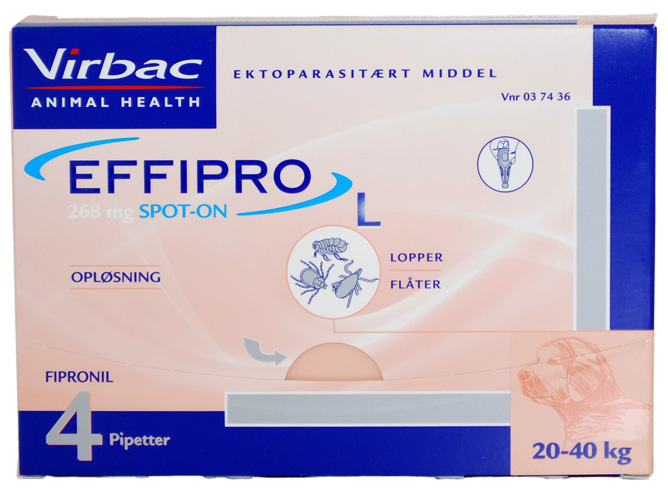
Effipro æsken indeholder 4 pipetter (til at dryppe i nakken). Dræber voksne lopper. Beskytter mod flåter. Aktivt stof: fipronil.
Effipro anvendes til behandling og forebyggelse mod angreb fra lopper, flåter og lus. Vi anbefaler, at du behandler med Effipro hver 4. uge.
Effipro indeholder et aktivt stof der dræber voksne lopper på hunden inden for 24 timer og flåter og lus inden for 48 timer efter behandling.
Effipro bør ikke anvendes til hvalpe under 2 måneder og/eller under 2 kg legemsvægt. Effipro bør ikke anvendes til syge eller afkræftede dyr. Effipro må ikke anvendes til kaniner.
Effipro kan også bruges til drægtige og diegivende tæver.
1) Effipro pipetten holdes lodret. Slå på den øverste smalle del af pipetten for at sikre, at indholdet forbliver i den nedre tykke del.
2) Knæk den øverste del af spot-on pipettens spids af langs den markerede linie.
3) Del hundens pels, så huden bliver synlig.
4) Anbring toppen af pipetten direkte på huden og klem blidt adskillige gange for at få indholdet ud.
5) Gentag proceduren på et eller to forskellige steder langs hundens ryg.
Effipro pipetterne fås i 4 størrelser, der passer til hunde med følgende vægt:
Effipro S: Vægt: 2 til 10 kg
Effipro M: Vægt: 10 kg til 20 kg
Effipro L: Vægt: 20 kg til 40 kg
Effipro XL: Vægt: 40 kg til 60 kg
Til hunde over 60 kg anvendes to Effipro L pipetter.
Effipro kommer i en pipette, der er: drypfri, nem at tømme, børnesikret og miljøvenlig. Effipro forhandles kun af dyrlæger.
I tvivl om hvilket loppemiddel du skal vælge? Se en oversigt over loppemidlerne til hunde her (scroll ned i bunden af siden).
- Forventes på lager indenfor 3-6 hverdage.
- Gratis levering ved køb over 299 kroner (til pakkeboks og erhverv)
- 30 dages returret*
- Fragt fra 29 kroner
- Du optjener 2,5% bonus på alle køb**
* Bemærk returretten gælder i følge lovgivningen ikke loppemidler.
** På din ordrebekræftelse får du en rabatkode på 2,5% af det samlede beløb, der kan indløses ved næste handel.
BEMÆRK: Specific-produkter sendes fra et andet lager end resten og afsendes samme dag ved bestilling senest kl. 10 på hverdage.
Tidligere spørgsmål:
Vi anbefaler dig også disse
Kunder der købte dette har også købt:
Tilmeld dig nyhedsbrevet og vind gavekort på 500 kr.
I nyhedsbrevet kan du forvente at få nyheder,

Frontline vs. Frontline Plus
Frontline and Frontline Plus are two medications and preventive products by Merial. These products are designed for household pets, particularly dogs and cats. The objective of both products is to eliminate fleas and ticks from the pets.
Both Frontline products aim to control the flea and tick population on a pet. They are applied topically (in layman’s terms, on the skin) at the back of the pet’s neck. The products’ main and active ingredient, Fipronil, is absorbed by the animal’s oil glands under the skin. After that, the ingredient travels to the hair follicles of the animal and targets the fleas and ticks.
Fipronil kills the ticks in less than 48 hours, while it can eliminate fleas in 12 hours. Both products work effectively 24 hours after application. They are also recommended to be applied once every month, ensuring one month of protection from fleas and ticks. Frontline and Frontline Plus can be administered without a veterinarian’s prescription.
Frontline was introduced in 1997 as a medication to control the flea and tick population on a pet. It is effective against adult fleas and ticks. Additionally, it is ideal to apply to indoor pets. In comparison with Frontline Plus, the original Frontline offers only partial tick and flea protection.

On the other hand, Frontline Plus was released in 2000 and has an additional ingredient – methoprene. Methoprene is a kind of insect growth regulator that kills the eggs and larvae of fleas and ticks. With this ingredient in combination with fipronil, Frontline Plus kills all fleas and ticks. To sum it up, it interrupts the flea’s life cycle and prevents fleas and ticks from reaching maturity. Because of this added ingredient, Frontline Plus provides more complete flea and tick protection.
This kind of Frontline product is more preferable to use for outdoor pets. It is also better to use this particular product if the animal has a flea or tick infestation. The product can eliminate the flea and tick populations effectively in a short amount of time.
1.Both Frontline and Frontline Plus are products used to control and eliminate the flea and tick population on pets. The method of application of both products is the same – topically by the skin. Both products are over-the-counter, meaning they can be bought without a prescription from a veterinarian.
2.Frontline and Frontline Plus share one manufacturer – Merial. They also are aimed at dogs and cats and share an active ingredient called fipronil. Both products offer one month of protection, and the main ingredient starts being effective within 24 hours of application.
3.Both products are cited as convenient to use, effective, and quick acting. Other recommendations for both products are their long-lasting effects and their waterproof features.
4.Frontline was released in 1997, while Frontline Plus debuted in 2000.
5.Frontline Plus is an improvement over Frontline; it has an additional active ingredient called methoprene, which kills the eggs and larvae of fleas and ticks. With methoprene, Frontline Plus kills not only the adult but also the young fleas and ticks.
6.Frontline is ideal for indoor pets; meanwhile, Frontline Plus is preferable for outdoor pets.
7.In terms of cost, Frontline is seen as more economical in comparison to Frontline Plus. The additional ingredient of methoprene and its desirable effects adds to the product costs.
8.Frontline offers only partial tick and flea protection, while Frontline Plus results in a comprehensive and complete elimination.
9.Frontline kills only adult fleas and ticks. In contrast, Frontline Plus eliminates both adult and young fleas and ticks.
10.The latter product is also ideal for a dog or cat with a flea or tick infestation.
Search DifferenceBetween.net :
Email This Post : If you like this article or our site. Please spread the word. Share it with your friends/family.
Celine. "Difference Between Frontline and Frontline Plus." DifferenceBetween.net. September 12, 2017 .
I need to know the difference between Frontline Plus , orange packs up to 22 lbs and Frontline plus” Spot On,” 1 to 10kg
Leave a Response
Written by : Celine. and updated on September 12, 2017
Mange in Dogs and Cats
By Michael W. Dryden, DVM, PhD, DACVM, University Distinguished Professor of Veterinary Parasitology, College of Veterinary Medicine, Kansas State University
Sarcoptic Mange (Canine Scabies):
Sarcoptes scabiei var canis infestation is a highly contagious disease of dogs found worldwide. The mites are fairly host specific, but animals (including people) that come in contact with infested dogs can also be affected. Adult mites are 0.2–0.6 mm long and roughly circular in shape; their surface is covered with small triangular spines, and they have four pairs of short legs. Females are almost twice as large as males. The entire life cycle (17–21 days) is spent on the dog. Females burrow tunnels in the stratum corneum to lay eggs. Sarcoptic mange is readily transmitted between dogs by direct contact; transmission by indirect contact may also occur. Clinical signs may develop anytime from 10 days to 8 wk after contact with an infected animal. Asymptomatic carriers may exist. Intense pruritus is characteristic and probably due to hypersensitivity to mite products. Primary lesions consist of papulocrustous eruptions with thick, yellow crusts, excoriation, erythema, and alopecia. Secondary bacterial and yeast infections may develop. Typically, lesions start on the ventral abdomen, chest, ears, elbows, and hocks and, if untreated, become generalized. Dogs with chronic, generalized disease develop seborrhea, severe thickening of the skin with fold formation and crust buildup, peripheral lymphadenopathy, and emaciation; dogs so affected may even die. “Scabies incognito” has been described in well-groomed dogs; these dogs, infested with sarcoptic mites, are pruritic, but demonstrating the mites on skin scrapings is difficult because the crusts and scales have been removed by regular bathing. Atypical, including localized, clinical forms that are probably linked to extensive use of insecticides or acaricides are being increasingly seen.
Diagnosis is based on the history of severe pruritus of sudden onset, possible exposure, and involvement of other animals, including people. Making a definitive diagnosis is sometimes difficult because of negative skin scrapings. Concentration and flotation of several scrapings may increase chances of finding the mites, eggs, or feces. Several extensive superficial scrapings should be done of the ears, elbows, and hocks; nonexcoriated areas should be chosen. A centrifugation fecal flotation using sugar solutions may reveal mites or eggs. A specific and sensitive commercially available ELISA to detect specific antibodies has been developed and may be useful. Because mites can be difficult to detect, if Sarcoptes is on the differential diagnosis list but no mites are found, a therapeutic trial is warranted.
Systemic treatments of scabies are based on administration of macrocyclic lactones, some of which are FDA approved for this purpose. Among them, selamectin is given as a spot-on formulation at 6 mg/kg. This drug appears to be safe, even in ivermectin -sensitive breeds. Another is the imidacloprid-moxidectin formulation, which may be used on dogs as young as 7 wk of age. In some countries, moxidectin is also registered for treatment of scabies. It is available as a spot-on formulation in combination with imidacloprid and should be given in two doses of 2.5 mg/kg, 4 wk apart; additionally, oral uptake should be prevented in breeds at risk of avermectin sensitivity. Other endectocides, such as milbemycin oxime and ivermectin , which are not registered for treatment of sarcoptic mange in dogs, have been reported to be effective depending on the dosage and route of administration. The recommended dosage for milbemycin oxime is 2 mg/kg, PO, weekly for 3–4 wk; potential toxicity should be considered in dogs with avermectin sensitivity. Ivermectin (200 mcg/kg, PO or SC, 2–4 treatments 2 wk apart) is very effective and usually curative. Ivermectin at this dosage is contraindicated in avermectin-sensitive breeds. Additionally, the microfilaremic (Dirofilaria immitis) status of the dog should be evaluated before treatment with a macrocyclic lactone. For topical treatment, hair can be clipped, the crusts and dirt removed by soaking with an antiseborrheic shampoo, and an acaricidal dip applied. Lime sulfur is highly effective and safe for use in young animals; several dips 7 days apart are recommended. Amitraz is an effective scabicide, although it is not approved for this use. It should be applied as a 0.025% solution at 1- or 2-wk intervals for 2–6 wk. In addition, the owner must observe certain precautions to avoid self-contamination. Fipronil spray was reported to be effective but should be considered an aid in control rather than a primary therapy. Treatment can be topical or systemic, and should include all dogs in contact.
Notoedric Mange (Feline Scabies):
This rare, highly contagious disease of cats and kittens is caused by Notoedres cati, which can opportunistically infest other animals, including people. The mite and its life cycle are similar to the sarcoptic mite. Pruritus is severe. Crusts and alopecia are seen, particularly on the ears, head, and neck, and can become generalized. Mites can be found quite easily in skin scrapings. Treatment consists of both topical and systemic therapies. Nonapproved but effective and safe treatments include selamectin (6 mg/kg, spot-on) and moxidectin (1 mg/kg, spot-on, in the imidacloprid-moxidectin formulation). Ivermectin (200 mcg/kg, SC) has also been used. Another effective topical therapy is lime sulfur dips at 7-day intervals.
Otodectic Mange:
Otodectes cynotis mites are a common cause of otitis externa, especially in cats but also in dogs. Mites that belong to the family Psoroptidae are usually found in both the vertical and horizontal ear canals but are occasionally seen on the body. Clinical signs include head shaking, continual ear scratching, and ear droop. Pruritus is variable but may be severe. Dark brown cerumen accumulation in the ear and suppurative otitis externa with possible perforation of the tympanic membrane may be seen in severe cases. Affected and in-contact animals should receive appropriate parasiticide treatment in the ears. Systemic therapies have been approved and include topically applied selamectin and moxidectin. Direct applications to the external ear canal of cats using approved ivermectin and milbemycin formulations are also effective. As a general rule, ear cleansing with an appropriate ceruminolytic agent is indicated with any therapy.
Cheyletiellosis (Walking Dandruff):
Cheyletiella blakei infests cats, C yasguri infests dogs, and C parasitovorax infests rabbits, although cross-infestations are possible. This disease is very contagious, especially in animal communities. Human infestation is frequent. Mite infestations are rare in flea-endemic areas, probably because of the regular use of insecticides. These mites have four pairs of legs and prominent hook-like mouthparts. They live on the surface of the epidermis, and their entire life cycle (3 wk) is spent on the host. Female mites can, however, survive for as long as 10 days off the host. Clinical disease is characterized by scaling, a dorsal distribution, and pruritus, which varies from none to severe. Cats can develop dorsal crusting or generalized miliary dermatitis. Asymptomatic carriers may exist. The mites and eggs may not be easy to find, especially in animals that are bathed often. Acetate tape preparations, superficial skin scrapings, and flea combing can be used to make the diagnosis.
Both topical and systemic acaricides are effective against cheyletiellosis, although no drugs are currently licensed for this indication. In addition to treatment of the affected animals, it is necessary to treat all in-contact animals. Topical drugs include lime sulfur, fipronil spot-on and spray, permethrin , and amitraz (the latter two are contraindicated in cats). Extra-label systemic drugs include selamectin spot-on, milbemycin oxime (PO), and ivermectin (SC). Care must be taken to avoid or minimize the risks of adverse reactions as described above (see Sarcoptic Mange (Canine Scabies)). The treatment period depends on the selected drug but must be long enough to eradicate the mites from both the animals and their environment, which can be difficult in animal communities (eg, breeding colonies, kennels). In practice, treatment lasts 6–8 wk and should continue for a few weeks beyond clinical cure until parasitologic cure is achieved.
Canine Demodicosis:
Canine demodicosis occurs when large numbers of Demodex canis mites inhabit hair follicles and sebaceous glands. In small numbers, these mites are part of the normal flora of canine skin and usually cause no clinical disease. The mites are transmitted from dam to puppies during nursing within the first 72 hr after birth. The mites spend their entire life cycle on the host, and the disease is not considered to be contagious. The pathogenesis of demodicosis is complex and not completely understood; evidence of hereditary predisposition for generalized disease is strong. Immunosuppression, natural or iatrogenic, can precipitate the disease in some cases. Secondary bacterial deep folliculitis, furunculosis, or cellulitis may occur, leading to a guarded prognosis.
Three forms of demodicosis are seen in dogs: localized demodectic mange, juvenile-onset generalized demodicosis, and adult-onset generalized demodicosis. Localized demodicosis is seen in dogs usually
Feline Demodicosis:
Feline demodicosis is an uncommon to rare skin disease caused by at least two species of demodectic mites. Demodex cati is thought to be a normal inhabitant of feline skin. It is a follicular mite, similar to but narrower than the canine mite, that can cause either localized or generalized demodicosis. One other species of Demodex (named D gatoi) is shorter, with a broad abdomen, and is found only in the stratum corneum. It causes a contagious, transmissible, superficial demodicosis that is frequently pruritic and can be generalized. In follicular localized demodicosis, there are one or several areas of focal alopecia most commonly on the head and neck. In generalized disease, alopecia, crusting, and potential secondary pyoderma of the whole body are seen. The generalized form is often associated with an underlying immunosuppressive or metabolic disease such as feline leukemia virus infection, feline immunodeficiency virus infection, diabetes mellitus, or neoplasia. In some cases, ceruminous otitis externa is the only clinical sign.
Diagnosis is made by superficial (D gatoi) and deep (D cati) skin scrapings, although mite numbers are often small, especially with D gatoi. Medical evaluation is indicated in cats with generalized disease. Dermatophyte cultures are essential, because dermatophytosis and demodicosis can be concomitant conditions. Prognosis of generalized demodicosis is unpredictable because of its potential relationship with systemic disease. Some cases spontaneously resolve. Weekly lime sulfur dips (2%) are safe and usually effective; amitraz (0.0125%–0.025%) has been used but is not approved for use in cats and can cause anorexia, depression, and diarrhea. The use of antiparasitic macrocyclic lactones has been reported but their efficacy is unclear.
Trombiculosis:
Trombiculosis is a common, seasonal, noncontagious acariasis caused by the parasitic larval stage of free-living mites of the family Trombiculidae (chiggers). It can affect domestic carnivores, other domestic or wild mammals, birds, reptiles, and people. Two common species found in cats and dogs, Neotrombicula autumnalis and Eutrombicula alfreddugesi, are reported in Europe and in America, respectively. Adults (harvest mites) and nymphs look like small spiders and live on rotting detritus. In temperate areas from summer to fall, dogs and cats can acquire the larvae as parasites when lying on the ground or walking in suitable habitat. In warmer regions, infestation occurs throughout the year. The larvae (0.25 mm long) attach to the host, feed for a few days, and leave when engorged. At that time, they are easily identified as ovoid, 0.7 mm long, orange to red, immobile dots, usually found clustering on the head, ears, feet, or ventrum. Pathogenicity is through traumatic and proteolytic activities. Hypersensitivity reactions are suspected in some animals, because pruritus may vary from none to severe. Lesions include erythema, papules, excoriations, hair loss, and crusts. When present, intense pruritus can persist for hours to several days even after the larvae have left the animal.
Diagnosis is based on history and clinical signs. The infestation is a seasonal threat to free-ranging dogs and cats. Differential diagnoses include other pruritic dermatoses. Diagnosis is confirmed by careful examination of the affected areas. Microscopic examination of samples obtained from skin scrapings may help to identify the larvae, which have an oval-shaped body densely covered with setae, six long legs, and curved pedipalps terminating in claws.
Management is difficult. The most useful approach, if feasible, consists of keeping pets away from areas known to harbor large numbers of mites to prevent reinfestation during periods of risk. The application of pyrethroids (dogs only) with repellent-like activity to prevent infestation has yielded variable results. Fipronil and permethrin (dogs only) can be used, both for prevention and treatment of infested animals. Symptomatic treatment may be required in cases of severe pruritus.
Straelensiosis:
Canine straelensiosis is a rare, noncontagious, sporadic, but potentially emerging parasitic dermatitis caused by the temporary encystment in the epidermis of the parasitic larval stage of Straelensia cynotis. This mite belongs to a family close to the family Trombiculidae. To date, the life cycle is largely unknown, and the disease has been reported only in France, Portugal, Spain, and Italy. Transmission occurs mainly in rural and small-sized hunting dogs, probably through contact with contaminated soil, litter, and other terrestrial habitat of foxes. No contagion has been reported to congeners and people. S cynotis has distinct differences from other trombidioid mites, especially in clinical presentation, histopathologic features, and response to treatment.
Straelensiosis is sudden in onset and may be accompanied by systemic signs such as anorexia and prostration. Lesions are painful, variably pruritic, and either generalized or multifocal, most often affecting the dorsal regions of the head and trunk. The characteristic erythematous papules and nodules resemble small craters. Scaling, pustules, and crusts can be seen.
Differential diagnoses include bacterial folliculitis, sarcoptic mange, and gunshot. Microscopic examination of samples obtained from deep skin scrapings may help identify the larvae (0.7 mm long, 0.45 mm wide), each in a thick-walled cyst. The larvae, which resemble Neotrombicula, are more easily visualized by histopathology.
The prognosis is favorable; a self-cure generally occurs after several months if reinfestation is prevented. However, management of clinical signs is difficult. Amitraz may be somewhat effective.
Lynxacariasis:
Feline lynxacariasis is a quite common but to date geographically restricted (Australia, Brazil, Hawaii, Florida, North Carolina, Texas) parasitic dermatitis caused by the fur mite Lynxacarus radovskyi, which belongs to the family Listrophoridae. The life cycle remains poorly described, and this species has not been reported from hosts other than cats. Infestation typically occurs by direct contact, but fomites may be important for transmission. Clinical signs include a salt-and-pepper appearance of the hair coat, variable pruritus, and alopecia. Diagnosis is based on visualization of mites (0.5 mm long) using a magnifying glass or on isolation of any parasitic stage in skin scrapings or acetate tape preparations. Treatment with acaricidal sprays, weekly lime sulfur dips, and ivermectin (300 mcg/kg, SC) are effective. The only case of contagion to people that has been reported involved a transient rash in an owner with a heavily infested cat.
Resources In This Article
Was This Page Helpful?
Also of Interest
Test your knowledge
A client calls her veterinarian because she has found a tick on her dog and she is not sure how to remove it. Which of the following is the most appropriate instruction for tick removal?
Merck and the Merck Veterinary Manual
Merck & Co., Inc., Kenilworth, NJ, USA is a global healthcare leader working to help the world be well. From developing new therapies that treat and prevent disease to helping people in need, we are committed to improving health and well-being around the world. The Merck Veterinary Manual was first published in 1955 as a service to the community. The legacy of this great resource continues as the Merck Veterinary Manual in the US and Canada and the MSD Manual outside of North America.
© 2018 Merck Sharp & Dohme Corp., a subsidiary of Merck & Co., Inc., Kenilworth, NJ, USA

Комментариев нет:
Отправить комментарий